


Hello everyone, and happy Thursday,
Dividend investors are some of the stickiest users on the internet. They’re just like day traders, but they actually have some degree of patience, or at least they think so. Once someone commits to an app, they defend it like a religion and show it off to all their other investor friends.
Today’s deal is a freemium dividend-focused portfolio tracker. You connect your brokerage, and it shows your dividend income, yield, upcoming payouts, and projects your future income. Bootstrapped, and founders want to move on.
Asking $650k, 3.4x profit, 2.5x revenue
TTM revenue $262k, TTM profit $191k, 73% margin
Last month: $19.9k revenue, $11.5k profit
Churn 5-10%, 3,000+ paying customers
120,000+ users in the database, founded June 2021
Laravel, Vue, and Flutter stack with brokerage integrations
If you’re new here, we analyze the deal flow and market trends we come across. Looking to buy or sell? Reply to this piece.
In short
The financials are declining. Annualize last month’s numbers, and you get $239k revenue and $138k profit, both below the trailing year. So it isn’t 3.4x. On run-rate profit, you’re paying 4.7x.
Margin fell from 73% to 58% in a few months, a 15-point drop that’s probably the new AI feature burning cash or a sharp decline in users.
ARPU is ~$5.30 a month. You can’t buy users at that price, so it runs on free traffic alone, and the traffic is flat.
The niche is crowded with cheaper rivals, and the brokerages already do this for free. Integrations and data feeds cost a fortune to run, so it’s at a disadvantage.
The primary asset is the list of 120,000 income investors, and there may be an opening to introduce social features or a media front to monetize attention.
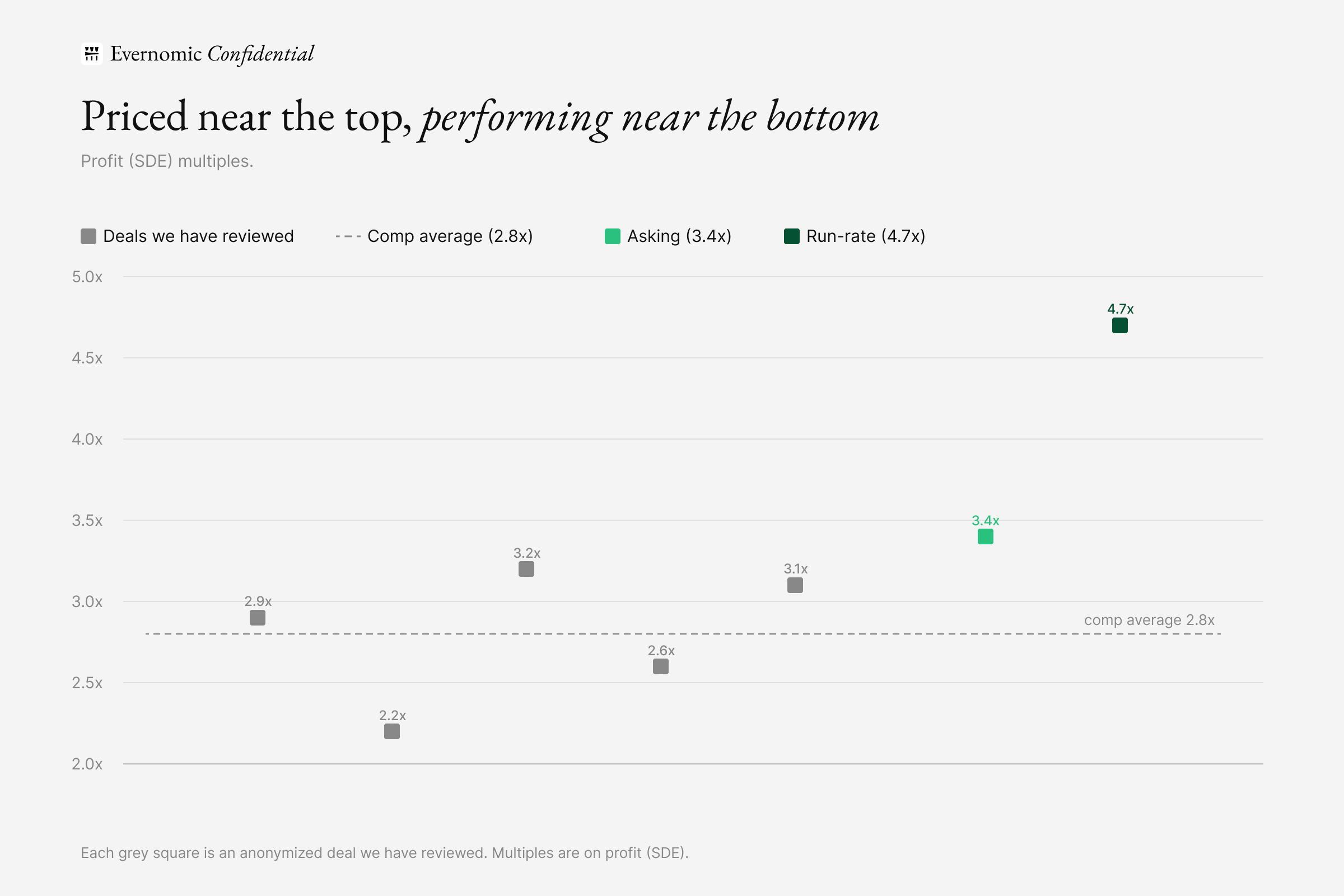
I’d pass at $650k. Comps sit at ~2.8x profit. There’s a deal only far lower, seller-financed, and only for a buyer who can do something with the list.
The listing is anonymized, so I can’t share month-by-month trends, but last month it generated $19.9k in revenue and $11.5k in profit. Annualize those, and you get about $239k and $138k, both below the seller's trailing figures of $262k and $191k. The financials are declining.
The listing references 3.4x trailing profit, which would be fair if it were true. But pay $650k against $138k of run-rate profit, and your actual multiple is 4.7x. I’d bet the multiple is even higher against the most recent months.
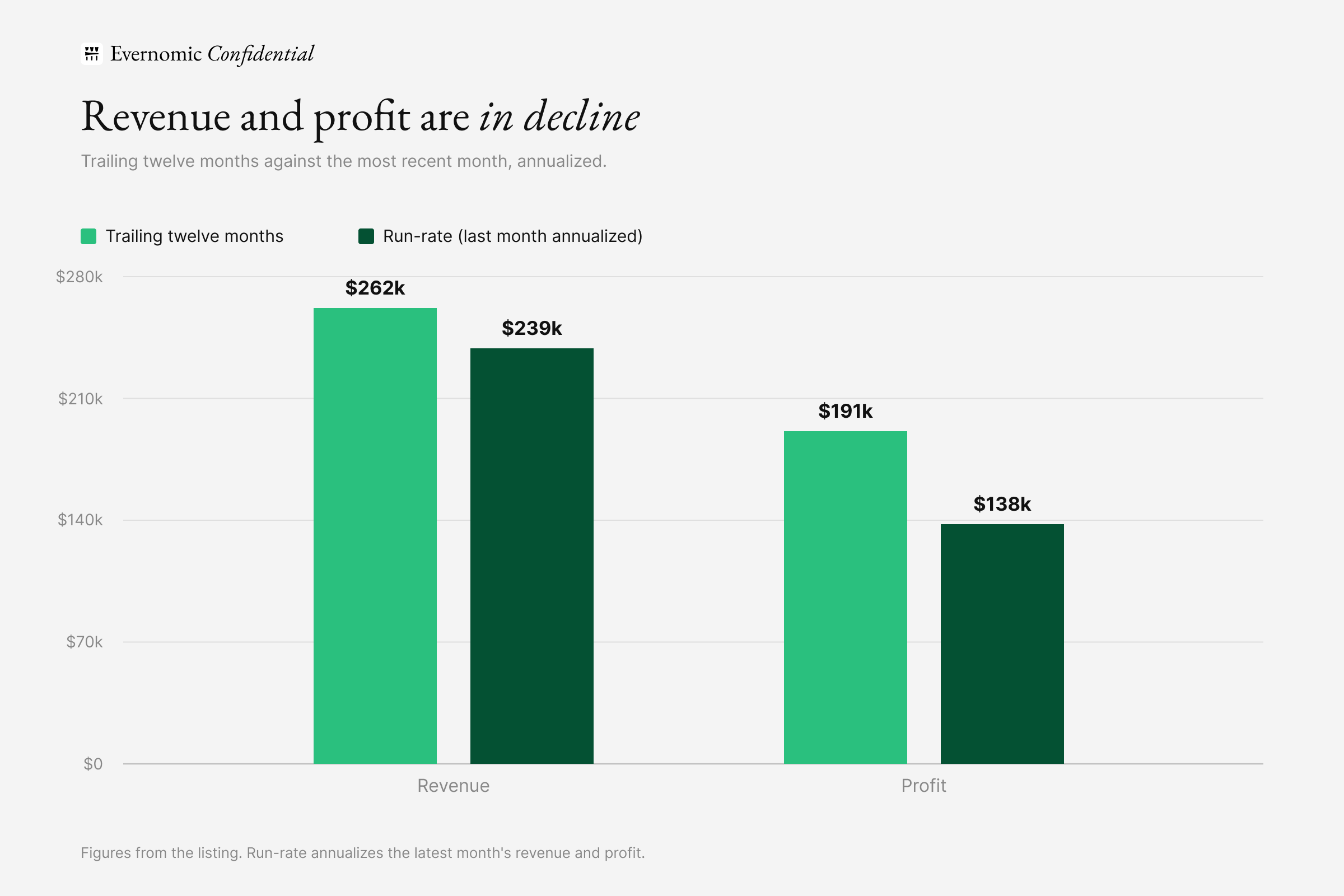
The margin doesn’t check out either. Across the year, it’s 73%, and last month it’s 58%. A 15-point drop over a few months usually indicates that a new cost has been added or that pricing has been reduced. I assume the OpenAI entry in the tech stack means they recently bolted on an AI insights feature. If that’s it, you’re paying API costs every month for something that, given flat usage and steady churn, probably doesn’t generate a return. I’d want to see monthly margins for the last twelve months, not the blended number.
The risks (and there are plenty)
The consumer finance space is an attractive space. Money gets thrown around. But it’s also highly competitive, and I don’t mean just in terms of literal competitors. CPC and CPM rates in finance are through the roof because there’s always someone who’s willing to outbid you, so paid acquisition becomes tricky. You either need to own your distribution or you need ridiculously high ARPU and LTV for the economics to work, which this app doesn’t have.
To estimate ARPU for this business, roughly $192k ARR across ~3,000 payers is about $5.30 per month. At that price, you cannot profitably acquire a user through any paid channel, so the business is dependent on organic and SEO.
Dividend tracking, specifically, is one of the most crowded niches in consumer finance. Sharesight has over 500,000 users; Getquin runs a free, ad-funded tier on a similar basis with $27m+ funding; and Snowball, Stock Events, DivTracker, and Capitally all cluster around $4 to $8 per month. Above all of them, brokerages keep adding native dividend-income views and calendars, which removes any reason a casual investor would pay for a separate app at all. Review sites in the space now routinely tell people to use a free tool or their broker’s built-in features.
Broker integrations and data feeds
My instinct for this sort of product would be to offer it for free and monetize elsewhere, but that becomes difficult if you have to pay a fortune just for your app to function.
A US dividend tracker connects via providers like Plaid or Yodlee (or scrapes), and investment account aggregation is both expensive per connection and notoriously poor at delivering clean dividend and corporate action data. You also need to ensure those connections transfer smoothly during an acquisition. If you have to force 3,000 paying users to re-link their brokerages, the re-auth prompt alone kills you.
Forward income projection also requires a licensed dividend-estimates feed. “Future income projections” and ex-date/payout data aren’t free. I remember back when I was building market analysis software, those very data vendors were the biggest pain in my neck.
The value may be in the list
Owning distribution in this niche is invaluable. I know a crypto humor Twitter page that makes $500k/year from a single sponsorship deal.
This app has (optimistically) 120,000 dividend investors. Brokerages, ETF issuers, and fintech tools all pay to reach exactly those people, and an income-investing newsletter to that list could plausibly earn more than the $16k a month the subscription generates. I’d treat the users as the core asset and build a media channel to serve them, monetized through sponsorships and brokerage affiliate relationships. I’d keep the tracker as the free hook that retains the audience rather than my selling point. This doesn’t necessarily need to be in the form of a newsletter. There are various finance apps with a consumption feed.
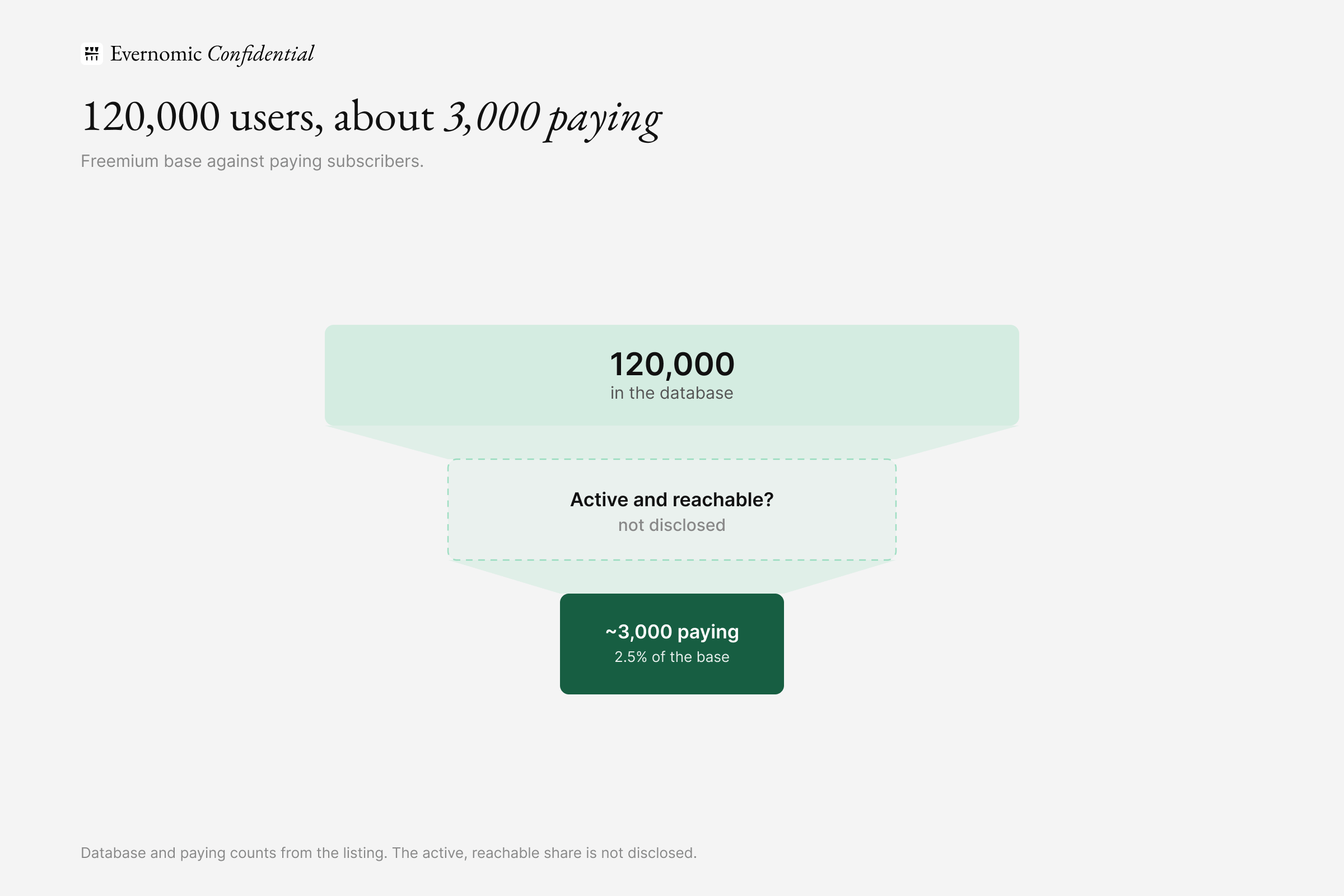
But as a counterweight to my own argument, the 120k “users” are almost certainly inactive in the majority. The app has been around for 5 years. If they had actually managed to retain users from their older cohorts, they likely wouldn’t be selling right now. Cold-blasting 120k stale addresses trips spam filters and drives sender reputation to the ground. The actual user base is anyone who has opened an email or the app in the last 90 days.
Trading 212 is one of my favorites, largely because of its social features, like sharing your “investment pie”. Building out features like that to retain users and increase DAU is the only path I see forward.
Demographics
Income investors skew older and wealthier, which is precisely who dividend-ETF sponsors and brokerages want to reach, so the ad/referral economics here are admittedly better than generic fintech. That said, the dividend-growth-investing crowd is unusually sales-resistant and frugal by self-selection.
I mentioned earlier that dividend investors were sticky users. While that may be an advantage in the context of existing users and new sign-ups, it also means it’s going to be that much more difficult to convince new users to migrate away from competitors to begin with. Dividend tracking isn’t a revolutionary, new concept. Most of your target audience already has an app they’re loyal to. The one opening I see is to target the trend of teenagers and people in their twenties getting into investing for “passive income.” The caveat is they’re a less valuable audience than established investors, but that’s where you stand a better chance.
Showing some personality could go a long way in converting a younger audience. Social features would also make every new user more likely to bring a couple of friends with them.
Questions I’d ask
I’m going to avoid the obvious (but important) questions around the use of language and whether this is clearly framed outside the scope of financial advice.
First, I’d want the last twelve months of monthly revenue, profit, and customer counts, not the blended trailing figures.
Why does ARR ($192k) sit below trailing revenue ($262k), and what exactly is the non-recurring piece?
Is the 5-10% churn monthly or annual?
What’s the voluntary versus involuntary churn split?
Better card retries and pre-dunning emails can recover failed payments. If the seller hasn’t done that, it’s a lever the new buyer could pull immediately.
The user base is the most important asset, but it’s, again, only anyone who has opened an email or the app in the last 90 days.
How were the 120,000 users acquired?
How many are reachable by email, and what’s the opt-in status of that list?
What’s the DAU and MAU? Are there new sign-ups coming in now?
On the product side, the only edge over free trackers and the brokerages is forward income projection and tax-aware reporting, which is what Sharesight charges for. So does it actually do that, or does it just show a yield?
Does it adjust cost basis for return of capital and split qualified from ordinary dividends, or is it just a yield number?
How do the brokerage integrations work, who maintains them, and how often do they break?
What does the AI feature cost to run, and did it move retention at all?
If it’s sending users’ holdings to a third-party AI, did users consent to that in the privacy terms?
So would I do the deal?
Certainly not at $650k, and probably not at all.
We recently sold an AI economic calendar SaaS with similar financials at 2.2x TTM revenue. The multiples on this deal are far too high.
Marketplace data on Acquire.com and Flippa for deals like this one runs anywhere from the low 2x to the mid 3s, and averages around 2.8x profit. You can’t value a business on revenue or profit alone, but there’s no standout metric and no unfair advantage here to lift the multiple.
The opening is the 120,000-investor list, with all the questions above still open. On that basis, I’d engage lower and structured, somewhere in the low three hundreds, with a good amount tied to revenue or retention holding through the next year, and the founders carrying part of that risk through the transition. If the list is clean and reachable, there’s a deal. If it’s mostly dead signups that no one can email, there isn’t one at all.
The buyer who fits this is a competitor, or someone who can put a higher-ticket offer in front of that audience right away. They can roll users into a healthier business instead of fighting a losing battle to grow this one. That’s also the buyer who can do it on heavy seller financing, since their track record and alignment reassure the seller that they stand a better chance. If I were advising the seller, I’d approach a few competitors immediately.
Evernomic Confidential only covers third-party deals we come across. We never write about anything Evernomic represents or holds a financial interest in. This analysis is for informational purposes only. It isn’t investment, financial, or legal advice, and we can be wrong. Do your own diligence before acting on any deal.