


Hello everyone, and happy Tuesday,
There’s this paradox with Main Street deals where if the deal is for sale, there’s almost certainly something wrong with it. It’s rare to see one with solid numbers that’s not on the brink of extinction.
Today I’m reviewing a monetization platform that lets creators charge for access to Telegram, Discord, and WhatsApp communities. It handles paywalls, sign-ups, renewals, and removals when someone stops paying, with an affiliate program built in to help creators grow. It takes 15% of what creators earn through it, or 4% if they pay $99 a month.
TTM revenue $730k, growing 42% year on year
TTM profit (SDE) $710k, 97% margin
Asking $4.1M, 5.8x profit, 5.6x revenue
500+ creators onboarded, churn 1 to 3%
Solo founder, bootstrapped, founded January 2023
Runs on Stripe with tiered take-rate model
About a decade ago, I tried my luck selling trading signals on Telegram, and a tool like this would have come in handy. No doubt, much of the user base consists of communities in that exact niche.
If you’re new here, we analyze the deal flow and market trends we come across. Looking to buy or sell? Reply to this piece.
In short
The revenue growth comes from existing creators getting bigger, not new ones signing up: traffic’s flat while revenue climbs. So the whole deal depends on who those creators are and how concentrated the money is. That list is the first thing I’d want.
The margin isn’t a software margin. The platform takes a cut on top of creator revenue, and the revenue is lower-quality than the number suggests.
The volume is probably from high-risk, high-chargeback categories: trading signals, crypto, and courses. It all runs through a single processor, so the biggest risk is Stripe deciding it’s too risky and cutting it off.
Whop ($142M) and Stan ($35M) are the largest competitors. The opening aims to attract higher-caliber communities to the platform by adding bundles, gifting, referral kickbacks, and the retention and growth tools that Substack and Patreon already use.
I would not do the deal at this price ($4.1M). Comps are trading between 2.2x and 3.4x SDE. It’s been listed for less than a month, the ask will drop, and if the creator list holds up, there’s a deal in the high two-millions with the seller carrying the risk.
The seller claims there has been zero marketing: no ads, no content, nothing. I don’t buy that for a second. No one launches something in utter silence and reaches $730K in revenue. There may have been no paid marketing, or an initial marketing push may have given them the momentum that took them where they are today. The take-rate model means revenue compounds as the creators on it grow, even without a single new sign-up. And that’s why the first thing I’d want is a list of their current creators. That’s everything.
Revenue is up 42% YoY while the site’s traffic has been flat to slightly down all year. Flat traffic and rising revenue on a fixed customer base also point to existing creators getting bigger, not new ones showing up. That could be a massive green flag depending on how concentrated the cash cows are. If a handful of large communities drive most of the take, you’re buying those few relationships, and any one of them can leave, fade, or get deplatformed by Telegram (unlikely) or Meta and walk off with a chunk of the revenue. In that case, the single-digit logo churn could be sitting atop a more concerning revenue risk.
Paid Telegram, Discord, and WhatsApp communities lean hard toward a particular set of things: trading and crypto signals, betting tips, reselling, get-rich courses, and the high-risk, high-chargeback end of the internet. That’s less a guess about this specific tool and more the shape of the whole industry.
Whop, the largest competitor on the list, is described across industry coverage as a home for exactly those gray-market sellers. It de-risks the platform by simultaneously routing payments through multiple payment providers to keep authorizations up. This tool runs on Stripe. So if a meaningful share is high-chargeback, the single biggest threat is Stripe deciding the volume is too risky and cutting it off. That risk doesn’t show in a P&L.
Comps
Whop raised $200M in early 2026 at a $1.6 billion valuation and runs north of a billion dollars in annual GMV across roughly 28,000 active sellers. Sacra frames it as a marketplace and toolset for selling digital products, courses, memberships, and betting tips, and as the checkout and discovery layer for grey-market creator SKUs: sneaker bots, sports betting lines, day trading tips, crypto, trading cards, and social media clipping.
The second-largest competitor is Stan, enabling creators to sell downloads, courses, and bookings from a link-in-bio storefront. You can actually view their verified revenue data here.
Whop, which launched an App Store in June 2025, is also building Chat by Whop (aimed straight at Discord) and Livestreaming by Whop (aimed at Twitch). Whop is the Amazon (a marketplace that compounds through demand-side aggregation) to Stan’s Shopify, and it overtook Stan in 2025 for exactly that reason.
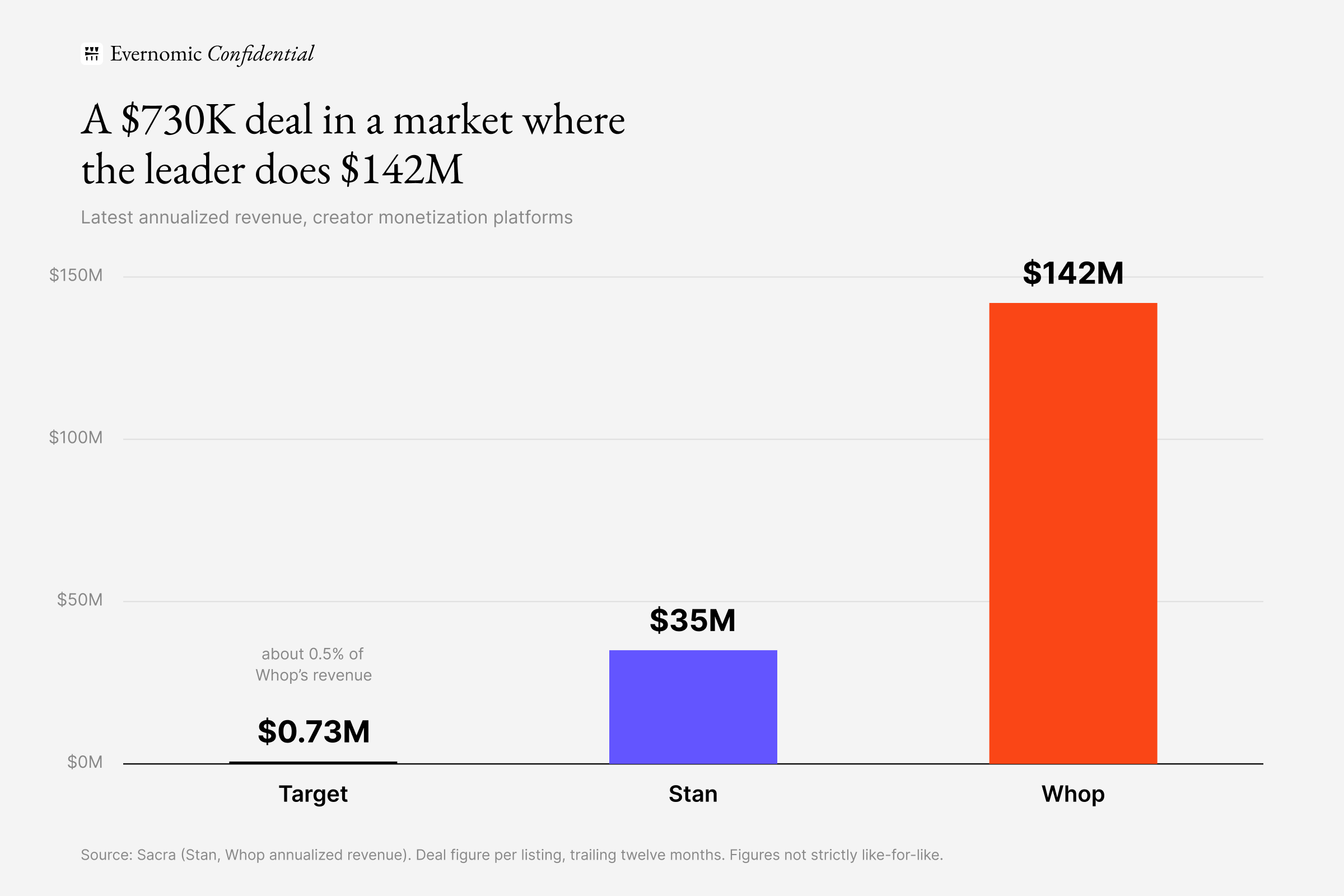
On multiples, I reviewed three other comparable deals, and they are asking between 2.2x and 3.4x SDE. 5.8x is definitely on the higher side. The more important issue is the multiple being applied to take-rate revenue, priced as if it were clean recurring software.
Opportunities I see
One obvious risk is that it’s an add-on to other platforms. If Telegram introduces paid communities tomorrow, you’ll almost certainly lose a chunk of your business if all you provide is a payment gateway. Now, it’s unlikely that WhatsApp, Discord, and Telegram would collectively introduce paid subscriptions, but counteracting this threat would be my first call to de-risk the business.
They already offer an affiliate program and a set of growth tools for creators, but I’d develop that further. I’d offer creators on the platform the option to bundle their subscriptions. I’d urge individual subscribers to gift free subscriptions to their friends to reduce churn at the subscriber level. I’d introduce a “recommendations” flow where creators can recommend other communities to their subscribers and earn a kickback.
You can take a page out of the books of other subscription-based platforms like Substack and Patreon, too. They’ve already done a lot of the heavy lifting to make subscriptions a reliable revenue stream for creators.
I wouldn’t double down on the high-risk niches, but if you do, introducing crypto payments for subscribers would certainly be in demand.
I’d focus on bringing higher-caliber communities onto the platform and using them as case studies to drive further growth. Advise.so is a good example, a community at the intersection of AI and marketing doing ~$25K MRR. The community itself is for sale, too. You can see its verified revenue and reach out here.
Questions I’d ask
As mentioned before, the first thing I’d want to see is the list of creators and everything there is to know about them.
What share of the take comes from the top ten communities? Who are they?
What’s actually sold through the platform, broken down by vertical?
Have you shared any success stories publicly?
What’s the split between Telegram, WhatsApp, and Discord?
I’d also want to learn more about the payment infrastructure.
Are creators on their own connected accounts, or is the platform the merchant of record?
What do chargeback rates and Stripe’s risk standing look like?
The fact that there have been no active marketing efforts so far is both impressive and an opportunity, but it raises the question of why. I can think of countless strategies, from using flagship creators as success stories to mass UGC campaigns and paid ads.
Did the seller try running ads before, and the results were negligible?
If so, was the CAC too high to continue? Did organic not see much traction?
Lastly, the founder is the one person handling product, support, and the integrations that break every time Telegram or WhatsApp ships a change, so what does replacing that work cost, and will they stay through a transition?
So would I do the deal?
That entirely depends on the answers to the questions above, especially regarding the creators. In either case, I wouldn’t do the deal at $4.1M. At the time of writing, they’ve been listed for less than a month. They’ll almost certainly be dropping the ask, and the multiple is far too high right now.
One thing I like about this deal is that it’s not vibe-coded garbage. The website is neatly designed, with a calculator to show how much you could earn as a creator, social proof, and everything else that makes for a high-converting landing page. You wouldn’t need to spend time optimizing the brand and could focus on growth immediately.
That said, the risks are too high unless you have the network to amplify this. If the answers hold up, I’d be in the high two millions, with a sizable piece tied to an earnout on revenue over the next year. I’d also consider heavy seller-financing. In either case, given the risk profile, I’d want the founder to share the risk during the initial phases.
Evernomic Confidential only covers third-party deals we come across. We never write about anything Evernomic represents or holds a financial interest in. This analysis is for informational purposes only. It isn’t investment, financial, or legal advice, and we can be wrong. Do your own diligence before acting on any deal.