


Good afternoon, everyone.
No one chooses not to spend time on something with a clear upside. So, to most sellers' surprise, when a deal requires “no time” to maintain, I don't usually see that as an opportunity.
Today’s deal is an email marketing tool built for SaaS companies: behavior-based emails, automated workflows, segmentation, and lifecycle messaging. Founded in June 2020, bootstrapped, and run by salaried operators while the owners build their next thing.
Asking $1.9M, advertised at 2.7x profit, 2.1x revenue
TTM revenue $917.1k, TTM profit $696.1k
Last month: $29.9k revenue, $9.9k profit
ARR $376k, churn 3-5% “stable”
~150 paying customers, operators cost $7.8k/mo
React, Node, Postgres on AWS Lambda
In the seller’s defense, they’ve shown another tool they launched recently that went from $9k to $43k in MRR in under two months, which is why they’ve shifted their focus and are looking to sell this one.
First time here? We analyze the deal flow and market trends we come across for independent buyers, search fund operators, and anyone seriously considering buying or selling a company.
In short
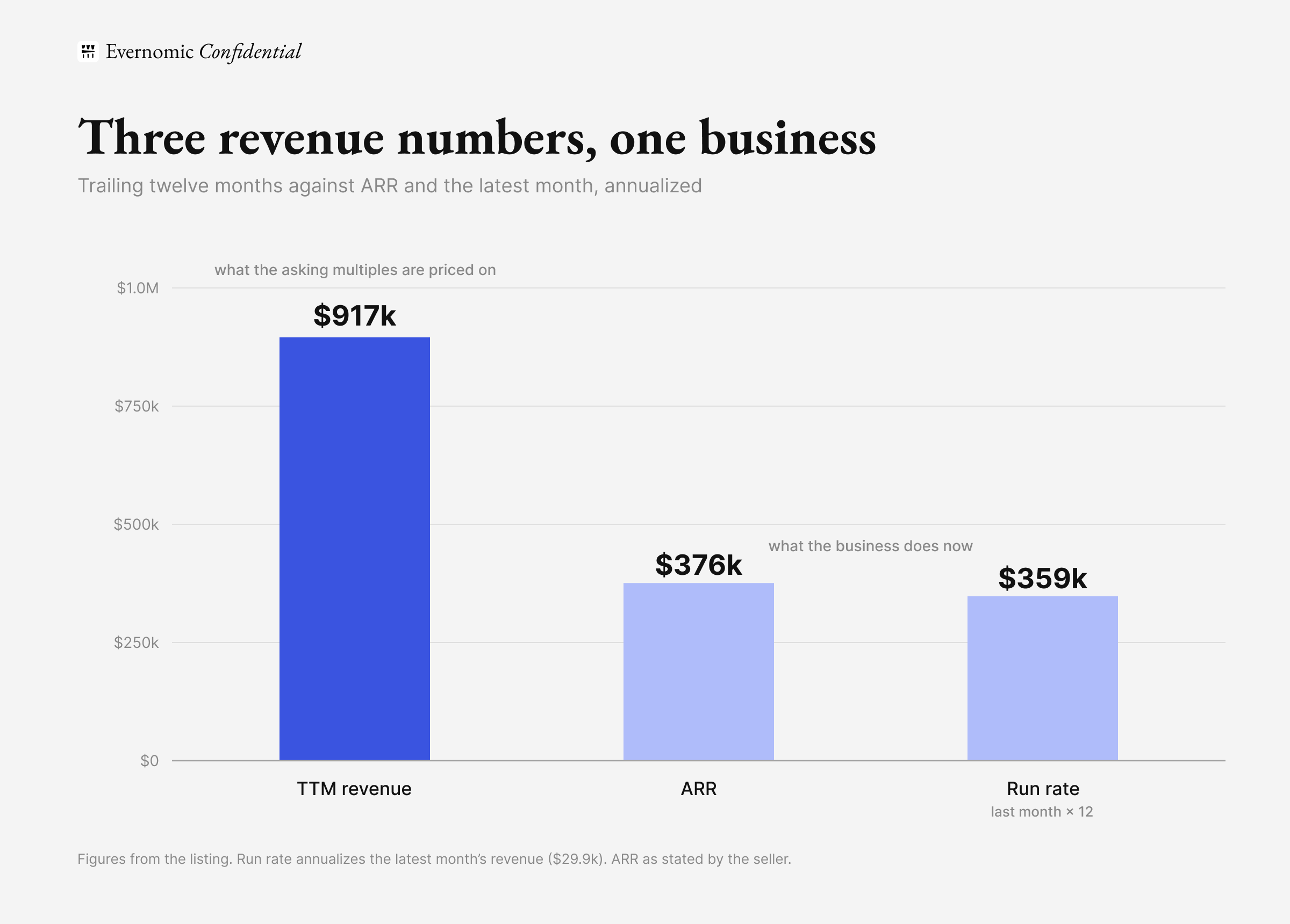
$917k TTM revenue, $376k ARR, $29.9k last month. The current month and the ARR match. But roughly $541k of the trailing year is gone.
The advertised 2.7x profit is priced off the old numbers. Against the run rate, $1.9M is 16x profit, and still 9x with operator salaries added back.
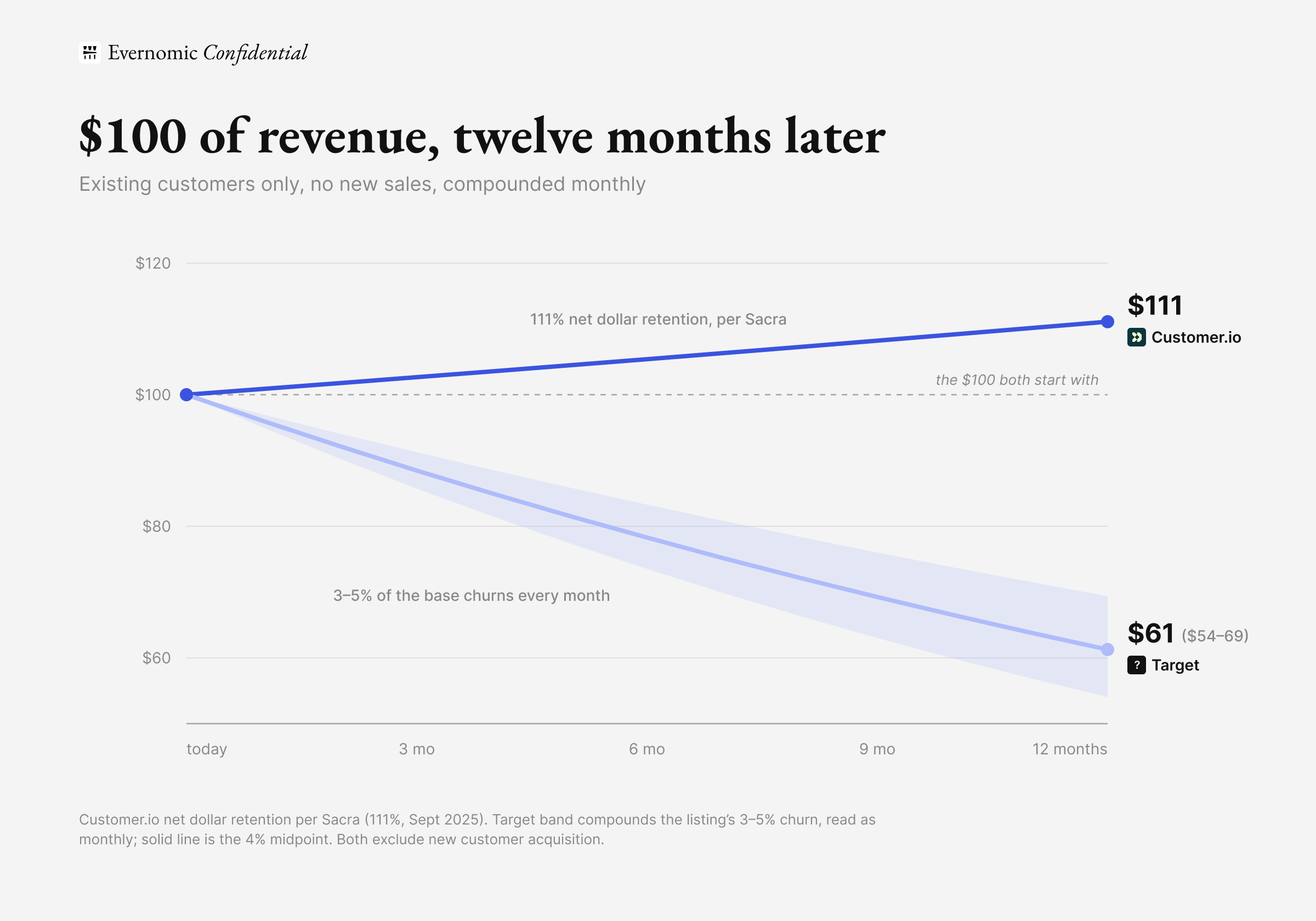
Competitors are Customer.io, Loops, and Resend, not Mailchimp or Klaviyo. Customer.io retains 111% of existing revenue. This loses a third.
The email provider matters. On SES, costs are lower, and the customer base is likely clean.
I’d pass at $1.9M. At 2.5-3x run-rate SDE, this is a $300-400k deal, seller-financed or earnout-backed, for a buyer already in the space.
The financials don’t add up
The business averaged $76.4k a month over the trailing year. Last month it did $29.9k. The stated ARR of $376k is $31.3k of MRR, so the current month and the ARR match, and roughly $541k of the trailing revenue is unaccounted for. Either MRR fell by more than half after the sellers walked away in August 2025, or much of the revenue wasn’t recurring.
Margin went from 76% over the year to 33% last month, with costs flat at $18-20k, so the decline is entirely due to revenue.
$1.9M against the run rate is 5.3x revenue and 16x profit. Add back $93.6k of operator salaries, and the run-rate SDE is about $212k. Still 9x.
The sellers also mentioned “good cash flow when yearly plans are purchased” as a selling point. It’s the opposite. That’s cash already collected for the service the buyer still has to deliver. I’d get the deferred revenue schedule and deduct it at closing.
Neglect kills email tools
Switching ESPs is a hassle (re-implementing event tracking, rebuilding workflows, re-warming domains), and that friction is this category’s appeal. But a product this “sticky” doesn’t lose half its revenue in ten months of absentee ownership.
Deliverability can’t be neglected. Gmail and Yahoo began enforcing bulk-sender requirements in February 2024: authentication, one-click unsubscribe, and complaint rates under 0.3%. Microsoft also began rejecting non-compliant high-volume mail since May 2025. An unmaintained ESP leads to lower open rates, customers blame the tool, and they migrate.
AWS Lambda can’t run persistent SMTP, so sending goes through SES or a third-party API. Which provider matters.
SES is the cheapest option (~$0.10 per thousand sends) and the strictest: AWS reviews accounts at 0.1% complaint rates, and pauses sending near 0.5%. If they’re still running on SES, it’s a good sign, since a bad customer base would have been suspended by now. If they’re with other providers, the tolerance is higher, but the cost is also several times that of SES.
I’d want to know what the complaint rates, blocklist history, and inbox placement look like before engaging.
Competition
The seller names Omnisend, Brevo, ActiveCampaign, Klaviyo, and Mailchimp as competitors. Those serve e-commerce and SMBs. A product pitched as “email built for SaaS companies” competes with Customer.io, Loops, and Resend.
Sacra estimates Customer.io passed $100M ARR in September 2025, growing 37%, with $38.8M raised. Loops also raised $3.2M to serve exactly this segment, with a free tier, unlimited seats, and transactional email included. Resend has taken the developer end, and Brevo’s free tier covers everyone too small to pay for anything.
The seller calls their 3-5% churn “stable.” If that’s the monthly figure, it’s 31-46% of the base per year, which explains the revenue decline on its own. The rate may be stable, but the customer base certainly isn’t. Customer.io retains 111% of existing revenue in this same category, while this deal loses a third of its revenue annually.
Questions I’d ask
The financials are concerning, so I’d start there.
Twenty-four months of monthly MRR, revenue, and customer count. Cash or accrual, stated explicitly.
What exactly is the $541k gap between TTM revenue ($917k) and ARR ($376k)? Services? Annual prepays? Churned accounts?
How much have customers prepaid for service not yet delivered?
Is the 3-5% churn monthly or annual? Gross revenue churn, not just logo churn.
What share of MRR sits in the top ten customers?
What does the “7% annual growth rate” measure?
Then the sending infrastructure.
Which provider (SES/SendGrid/Postmark) is being used, and is the account in good standing? SES is the cheapest, but also the strictest on suspension.
Monthly sending volume, complaint rates, bounce rates, and blocklist incidents over the last twelve months?
Are the customer’s sending domains DMARC-compliant?
And lastly, what do the operators actually do? What are their contracts, and will they stay?
So would I do the deal?
Absolutely not at $1.9M. The founders are trying to cash out based on a historical financial profile that completely vanished over the winter.
On a current run-rate basis, adjusting for market competition and churn, a fair multiple would be between 2.5x and 3.0x SDE. If the codebase is solid and the remaining customer base is proven sticky, a realistic valuation is between $300,000 and $400,000.
The deal would need to be structured with some seller financing or a performance-based earnout to offset the risk of decline, too. If the sellers want to hold out for a million-plus valuation based on old data, let them keep ignoring it until the revenue hits zero.
That said, I do see an opportunity in this space despite the competition. Software is no longer the bottleneck it used to be, and you could compete with the larger names by running far leaner than they do. So, the buyer who fits is someone in this space who can absorb the customers onto infrastructure that is actually maintained. For everyone else, you’d have to fight someone else’s battle because they decided this was no longer worth their time.
Evernomic Confidential only covers third-party deals we come across. We never write about anything Evernomic represents or holds a financial interest in. This analysis is for informational purposes only. It isn’t investment, financial, or legal advice, and we can be wrong. Do your own diligence before acting on any deal.